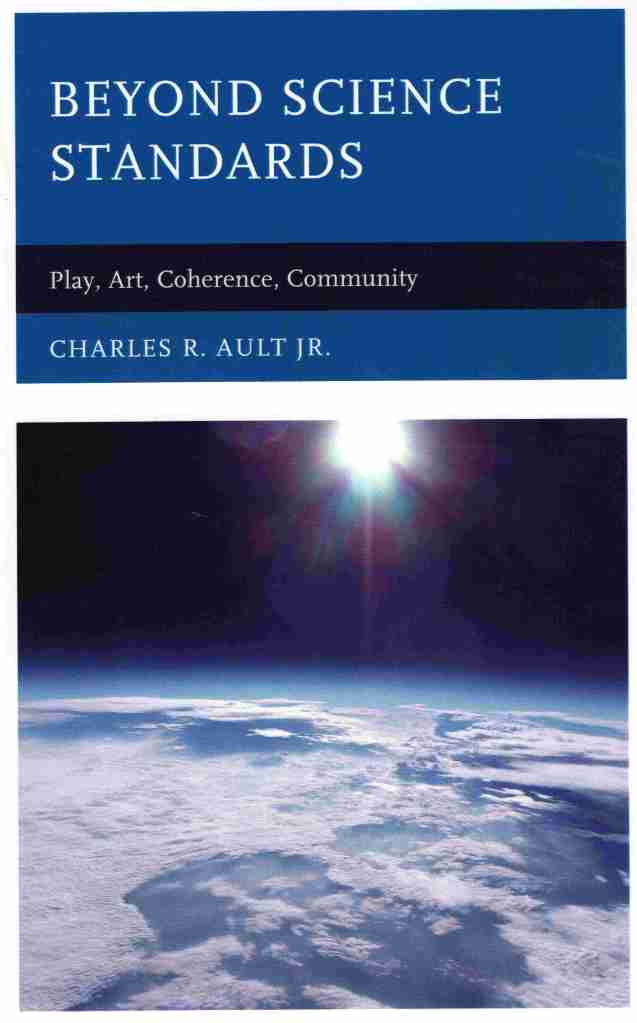
Reviews
I’ve never read such a fascinating, beautifully written work. Ever. On Beyond Science Standards a bellwether book in the field of science teaching, shares an amazing journey of whimsically named stories that take us into real classrooms to experience science content selected and designed with the needs and aspirations of students in mind. Kip Ault has written the book that I’ve been waiting for—a journey uncovering aspects of ourselves and the universe promising immense pleasure and joy.
–Jack Hassard, author of The Art of Science Teaching,
Professor Emeritus of Science Education, Georgia State University
A lifetime of science teaching culminates in this author’s rich collection of stories—filled with intrigue and insight. Reading this book will forever elevate one’s appreciation for science and to fully recognize its presence in every dimension of human experience.
–John Settlage, Professor, Neag School of Education, University of Connecticut
Science Standards have their place, but the search for common “practices, core ideas, and crosscutting concepts” carries the liability of homogenizing scientific disciplines and losing their rich diversity. As a geophysical researcher, I studied the tectonic development of the Andes with practices and techniques that had little in common with those of a geneticist searching for mutations responsible for Parkinson’s disease. Through stories of scientific discoveries basic and profound in On Beyond Science Standards, Kip Ault embraces the diversity of scientific disciplines and celebrates how science educators can guide their learners to sample that diversity while using the touchstones of “play, art, coherence, and community.”
–Robert Butler, Professor Emeritus, University of Portland
Beyond Science Standards gives you the feeling that you are talking with Charles “Kip” Ault in his class. In concise and clear language, Kip explains how to “think like a geologist” even when the rocks you study are in a hotel lobby. Using stories, experiments, and observations, hemakes explanations vivid and understandable.
— Chen Ljuan, doctoral student, Beijing Normal Universityi
As I read On Beyond Science Standards, I found myself smiling, remembering my days as a middle school science teacher, trying to navigate the dual complexities of science and teaching, while trying to foster a classroom in which kids felt safe to explore, tinker, and feel joy at asking and answering questions. I realized that my enjoyment of the book came from, the stories of actual classrooms and real kids and their teachers’ genuine efforts to do good work. The stories nicely illustrate the joy, messiness, and wonderful reality of science classrooms. As a reader, you feel transported into these spaces, eagerly awaiting updates about the students and the science. Rarely are people, including researchers, given such a whole picture of daily classroom life. Rather than the atomized examinations of a single feature of classroom life, this book takes a panoramic perspective, inviting readers to experience the sights, sounds, and smells of classrooms.This book illustrates how classrooms can become special as the teachers and students enjoy working and learning together. If nothing else, know that I am now drifting off into nostalgic memories of John J. Pershing middle school in Houston, where I taught students who are now doctors, musicians, dancers, lawyers, and realtors. What we share—our classroom experiences—are nicely captured in this book.
–David Stroupe, Ph.D., Associate Director for STEM Teacher Education, Michigan State University
It is easy to think of modern natural science as an experimental, laboratory-based and sometimes algorithmic undertaking. On Beyond Science Standards tackles that perception head-on, engaging and prompting readers to engage in the rich diversity of scientific thinking and methodology across contexts and disciplines. Charles Ault demonstrates convincingly how scientists use their imagination to engineer systematic methods of inquiry that respond to the questions they ask, rather than relying on a singular, algorithmic method. Not only does the book’s central thesis demonstrate how the natural sciences can be made inviting to a much broader spectrum of people, it also illustrates why a broader perspective on the natural sciences is necessary to address many of the wicked problems we face as a global community.
–Marianne Achiam, Associate Professor of Science Education, University of Copenhagen
 Kip Ault's Homepage